


Motorcycle Trip in Nepal – Important Information
Experience the ultimate motorcycle trip in Nepal and discover one of the world’s most thrilling riding destinations. Nepal offers an unforgettable blend of Himalayan landscapes, remote mountain trails, ancient culture, and challenging off-road adventures that attract motorcycle enthusiasts from around the globe. Whether you are an experienced rider or an adventure seeker looking for a once-in-a-lifetime journey, a motorcycle tour in Nepal promises excitement, freedom, and breathtaking scenery at every turn.
One of the most iconic adventures is the Mustang Motorcycle Tour in Nepal, a spectacular ride beyond the Annapurna mountain range into the legendary Upper Mustang region. This extraordinary journey takes riders through dramatic valleys, rugged terrain, traditional Himalayan villages, and one of the deepest gorges in the world — the Kali Gandaki Gorge. The route is widely regarded as one of the most scenic and adventurous motorcycle roads in the Himalayas.
Nepal is considered a safe and welcoming destination for international travellers and motorcycle riders. The warm hospitality of the Nepalese people, combined with the country’s rich cultural heritage and natural beauty, makes every motorcycle trip in Nepal a truly rewarding experience. However, riders should understand that Nepal is still a developing country, especially in remote mountain regions. Road conditions, infrastructure, and facilities may differ significantly from those found in Europe or other developed nations, which is part of the authentic adventure experience.
Best Time for a Motorcycle Trip in Nepal
The best seasons for a motorcycle tour in Nepal are spring (March to May) and autumn (September to November), when the weather is generally stable, skies are clear, and mountain views are at their finest. Winter rides until February can also be enjoyable in many regions with cooler temperatures and less traffic.
The monsoon season, usually from June to August, brings heavy rainfall that can create difficult riding conditions, including landslides, muddy roads, and flooding in certain areas. Riders travelling shortly after the monsoon should also be prepared for occasional rain showers and rough road sections that may not yet be fully repaired. Carrying quality waterproof riding gear is highly recommended for comfort and safety.
Adventure Riding Conditions in Nepal
A motorcycle trip in Nepal is not just a scenic ride — it is a real adventure. Riders must stay alert and focused while enjoying the incredible Himalayan scenery. Mountain roads can be steep, narrow, muddy, rocky, and slippery, with occasional river crossings and unpredictable terrain. These challenging conditions make Nepal one of the most exciting motorcycle adventure destinations in the world.
Riders should always ride within their skill level and avoid taking unnecessary risks. Patience, preparation, and careful judgement are essential for a safe and enjoyable journey. For solo riders, seeking local assistance when needed is highly recommended. For group tours, having an experienced support team and mechanical backup can make the adventure smoother and safer, especially in remote mountain areas.
A few important steps help you accomplish your riding trips:
Our mission is to get you to your planned destination, have a beautiful experience filled with enjoyment from the trip, and return home safely. Safety when riding comes first to prevent injury and save life. Safe-riding tips are mentioned below to raise your awareness and clarify how we ride in Nepal.
Riding Solo: Riding alone without a companion
A solo rider has little to consider, but plan your journey carefully. Start early and finish early is always best here in Nepal as you may get unexpected stoppages sometimes during the journey due to poor road infrastructure, traffic incidents, or sudden protests etc. It is always a good idea to ask the locals at your hotel about the situation before you proceed to your next destination.
Riding in a group: Riding in a team of 2 or more
While you ride in Nepal, follow the following steps:
- - Stay as a group when you are riding with friends.
- - Never leave the mechanic if you have one and are riding with a support team.
- - Follow the tour leader.
- - Keep a safe braking distance.
- - Do not panic if you get lost or miss the road. Navigate your way back or stay where you are confused until one of your support member finds you.
- - Get involved in rehearsal prior to departure for a ride to get used to in the event of lost or unexpected incidents.
- - Please keep a record of the contact number of a guide, mechanic, or tour leader.
Mechanical issue with your motorcycle:
Motorcycle stops and won’t start:
- - Do not panic!
- - Turn off the key once, then try to start the bike using the correct method. Rush creates more trouble.
- - If failed to start multiple times - do not use electric-start continually—the battery may drain and clutch sprag will wear out too, that leads to engine lock up.
- - Use the kick start method properly to start the bike
- - Never try to repair a bike yourself if you don’t have any mechanical knowledge.
- - Stay where you are stopped and ask for help if some riders show up interest in your situation. Mostly on Nepalese roads these days, many youngsters have emerged as passionate riders, travellers, and bloggers who are found to be great helpers to other bikers.
Nepal is a tourist-friendly country as we have a concept of thinking that guests are representations of gods. Nepal is not only beautiful but also a perfectly safe country for everyone living here or visiting here. If you are riding in a group, you shouldn’t worry as you will be searched by support staff. Inform the mechanic immediately about any issues you encounter.
Healthy Bike – Healthy Ride - Healthy Ride – Happy Guy
Tyre Puncture/ways to avoid:
A significant amount of time gets wasted if you get a puncture on the tour.
Precautions for tyre punctures:
On the Highway: There are lots of nails on the road, especially in ditches, so avoid ditches and potholes while riding along the Nepalese Highway.
On off-road: Never ride over sharp stones and avoid wheel spins on those rocks.
Traffic in Nepal & Safe Riding Tips:
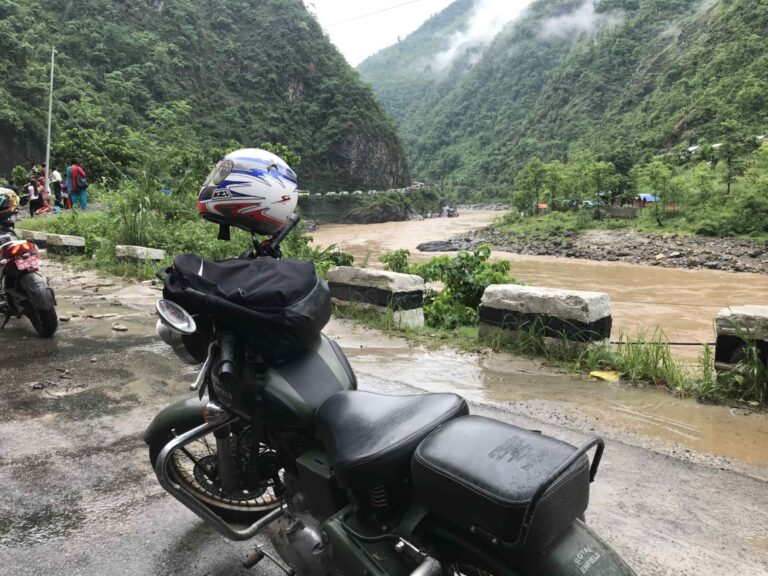
Royal Enfield 500 Battle Green
World-class traffic rules are in place in Nepal, but there are only a few people who follow traffic rules while driving, so
- Always ride defensively by thoroughly understanding the situation.Always protect yourself. Do not expect from other traffic.
- Never expect other traffic to give you the right of way. Make your own way very carefully and with good anticipation.
- Always use horn in time, when you see hazards, going around bends & overtaking.
- Always prepare to move to the left side of the road or stop instantly when you meet an overtaking vehicle from the opposite side.
- Always stay in your lane unless necessary. Think about lane discipline!
- Never ever overtake around bends.
- Never do excessive banking on any Royal Enfield, otherwise the foot rest may touch the road and you may lose control.
- Always maintain a gap and keep your braking distance.
- Always ride at your controllable speed. It depends on individual riding skills, experience, and the condition of the road and the capacity of the bike.
- Ride carefully in the cities (speed limit is 40 km/h). Get familiar with how traffic is flowing.
- Never ever stop in the middle of the carriageway under any circumstances. Always use your indicator, check traffic and pull over only at a safe place for stops.
- Follow traffic light signals.
- Always wear a helmet. If you have good riding gear, it is a clear definition of your awareness.
POLICE CHECK
Always cooperate with the police politely when you are going through their checkpoints. They are there to help, so do not hesitate to get assistance if necessary.
PARKING MOTORBIKE
- - Always park your motorcycle in a safe location during the day and lock the handle.
- - At night, always park your motorcycle on the centre stand and in close proximity.
- - Never leave your motorcycle on a public road overnight.
- - Start and let your motorcycle run for 10 minutes, even if you are not using it every day, to make sure everything is functional for the next trip.
- - To avoid unexpected breakage, never turn a motorcycle around using a side parking stand.
Ways to solve the starting problem on motorcycles - Royal Enfield
Get free mechanical assistant from Bikemandu Motorcycle Club “BME”HUB
Basic tips are listed below, if you struggle with starting your motorcycle. For combustion, an engine needs three fundamentals: fuel + air + electricity.
- Lift the fuel tank lid to let trapped air out of the tank. The trapped air can create a vacuum and prevent fuel transmission from the fuel tank to the engine.
- Check - fuel level by rocking the bike left and right, sometimes the fuel indicator can be faulty.
- Check - the spark plug is securely connected.
- Check - the air hose from the air filter box to the carburettor or throttle body to the engine is properly connected.
- Check electricity by pressing the horn. If it beeps - the motorcycle has electricity.
- If a motorcycle is equipped with carburetor, check the fuel supply switch under the tank is not in the “OFF” position. The fuel supply switch must be either “ON” or Reserve - if less fuel remains in the tank.
- If your motorcycle has a kick lever, lubricate the piston and cylinder wall by kicking the lever a couple of times.
- Now, press the electric start button not exceeding 2 –3 seconds after turning on the red ignition button.
A. Motorcycle starts:
Let it warm up for 2 - 5 minutes before the ride. Chill out. Grab a cup of coffee before you go!
B. Motorcycle Fails to Start
If the motorcycle has an electronic fuel ignition system and has a choke lever. Press the lever then repeat no 8.
C. Motorcycle starts
Let it warm up for 2 - 5 minutes before the ride.
D. Motorcycle doesn’t start:
Repeat no 8. You may use kick start for better efficacy!
Motorcycle has Carburettor. Pull the choke lever at the carburettor then repeat no 8. You may use kick start for better efficacy.
E. Motorcycle still doesn’t start:
Look around some garages nearby. Ask for assistance with locals or passers by. In Nepal, there are many workshops almost everywhere along the roads. If it is difficult to find assistance, call Bikemandu 24 Hour Service/WhatsApp: +977 9803522833 and we will find a way to get you moving from there. Service available to Bikemandu customers only. Sorry, we can't advise others.